
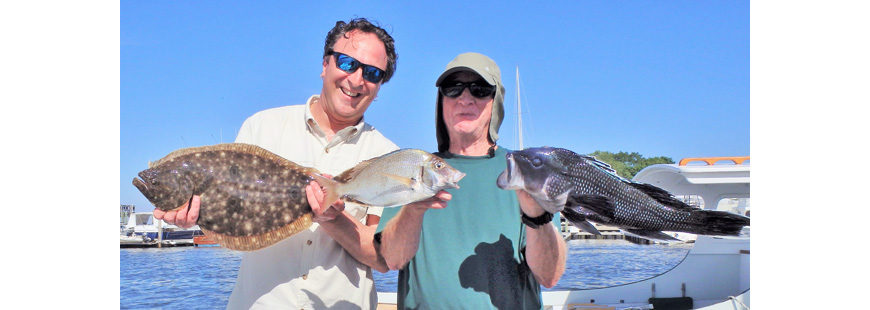
Top photo: Summer flounder, scup and black sea bass caught in Narragansett Bay, by Dave Monti
On August 31, 2026, the National Marine Fisheries Service (NMFS) released revised recreational catch, landings, and effort data, which resulted from changes made to the Marine Recreational Information Program’s Fishing Effort Survey. The revised data is now available for fisheries managers to use in stock assessments and in crafting new management measures.
NMFS learned of problems with the Fishing Effort Survey in the summer of 2023, after a pilot study determined that some anglers were overstating the number of fishing trips that they took during each two-month “wave” used by the Marine Recreational Information Program (MRIP) to compile recreational catch, landings, and effort data.
Because the MRIP methodology multiplies the estimated number of trips taken by anglers, derived from the Fishing Effort Survey, by the average number of fish of various species caught by anglers on each trip, a figure derived from the separate Access Point Angler Intercept Survey, to estimate the overall number of fish of each species that are caught, landed, or released, anglers overstating the number of fishing trips taken will result in the catch, landings, and release estimates being overstated as well.
NMFS has revised the Fishing Effort Survey’s format, to make overreporting effort far less likely, and has revised the catch, landings, and effort data to adjust for overreporting in the past. The size of the downward revisions differs from species to species, but were often substantial. Total striped bass catch in 2024, for example, fell from an original estimate of 20,822,514 fish to a revised estimate of just 14,323,640, a reduction of 31.2%; live striped bass releases went from the original estimate of 19,093,770 to a revised estimate of 13,111,145, a 31.3% reduction.
Summer flounder, on the other hand, showed a much smaller reduction, with the original catch estimate of 29,993,105 fish revised downward by only 6.88%, to 27,929,969 fish.
The magnitude of the revisions can also vary widely by state. So, while the revised estimate of 2024 summer flounder catch for all of New England and the mid-Atlantic was only 6.88% lower than the original estimate, in New York, the difference was much greater, with an original catch estimate of 11,759,579 fish revised downward to 9,141,822, a reduction of 22.3%, more than three times greater than the coastwide revision.
The big question is what happens next.
In its August 31 release, NMFS advised that “This data revision does not trigger immediate fisheries management changes or adjustments to catch limits. NOAA Fisheries and regional partners will begin integrating the improved data into prioritized stock assessments to help determine the health of stocks and provide new management advice, if warranted, through standard public processes.”
But that measured response doesn’t change the fact that the new data will be used in some of the highest-visibility and most politically charged stock assessments on the East Coast, including the pending assessment of South Atlantic red snapper and the 2027 benchmark stock assessment for Atlantic striped bass. The revised data will also be used in the planned 2027 management track stock assessments for summer flounder, scup, and black sea bass, which will be used to determine 2028 and 2029 recreational management measures. In the case of bluefish, the revised data will be used in a 2027 management track stock assessment that will determine whether that once-overfished stock has been fully rebuilt; if it has, the same assessment will be used to set recreational management measures for the 2028 and 2029 fishing years.
So there will be a lot of eyes focused on those assessments, and on the impact that the revised data will have. Some members of the recreational fishing community are undoubtedly ready to condemn the data if it results in more restrictive regulations, and to reluctantly praise it if it allows higher harvests. Others are just watching to see how things go.
Some recreational fishermen, and some members of the recreational fishing industry, believe that the revised recreational landings data show that past and current regulations were too restrictive, and that the new data will allow managers to adopt more liberal rules. We saw an example of that at the September 15 meeting of New York’s Marine Resources Advisory Council (MRAC), when two MRAC members, both representing the recreational fishing industry, complained about the supposed harm done to their businesses by the overestimates of recreational landings, with one even talking about the possibility of a lawsuit against NMFS for the economic harm caused by the resulting management measures.
They were missing a very important point. The fact that recreational removals were less than originally estimated doesn’t mean that regulations had been too restrictive, for those estimates of recreational landings and release mortality are fed into the stock assessment models, and the models’ response isn’t necessarily what people expect it to be.
The 2018 benchmark assessment for Atlantic striped bass provides a perfect example.
In 2018, biologists faced a situation that was just the opposite of the one that they’re confronting today. The current Fishing Effort Survey had just been introduced, and the data that it was producing indicated that anglers were making more trips, and catching and keeping more fish, than previously believed.
In the case of striped bass, the new survey revealed that landings were 160% higher than managers had thought, while overall recreational catch was 140% higher. When that information was fed into the stock assessment model, the estimate of spawning stock biomass (SSB) didn’t decrease, as one might intuitively expect if more fish were removed from the population, but rather increased from the 58,200 metric tons estimated in the 2013 benchmark assessment to 68,476 metric tons in 2018. The reference points used to determine the health of the stock, which are based on the estimated SSB in 1995, were also revised, with the SSB target, defined as 125% of 1995 SSB, increasing from 72,032 to 114,295 metric tons. The SSB threshold, which defines an overfished stock and is equal to the estimate of 1995 SSB, was increased from 57,600 metric tons in 2013 to 91,436 metric tons in 2018, as the 1995 data was recalculated to reflect the new understanding of recreational catch and landings in that year.
Thus, just as SSB estimates for striped bass, as well as some other species, increased more-or-less proportionately to the increase in estimated recreational landings, it is possible that, when the lower estimates of recreational catch and landings are used in upcoming stock assessments, they will result in lower estimates of SSB, and lower SSB target and threshold reference points, than exist today. In such cases, if recreational landings and the estimate of SSB both decline by roughly the same percentage, there may well be no need to adjust recreational management measures at all.
However, we shouldn’t assume that the SSB estimate will always decline in proportion to the lower, revised recreational catch and landings estimates. When I asked a biologist employed by New York’s Department of Environmental Conservation, at the same September 15 MRAC meeting mentioned above, whether SSB estimates would necessarily decline in concert with catch and landings estimates, she properly chose not to answer, noting that recreational catch and landings are only one of many inputs into stock assessment models, and the results of the assessment can’t be predicted by the decline in recreational removals alone.
However, in those cases where estimates of SSB and estimates of recreational catch and landings move together, some interesting questions related to the commercial fishery arise.
Commercial quotas, as calculated for most species (but not for striped bass), allow the commercial fishing sector to remove a fixed percentage of a fish population each year. So, if the estimate of SSB for any species is too high, as a result of overestimates of recreational catch and landings skewing the stock assessment, the commercial quota for that species will probably be too high as well and, through no fault of the commercial fishermen, lead to too many fish being removed from the population.
There is also another way that the revised recreational data could impact the commercial fishery.
After the Fishing Effort Survey was first put in place, and past landings data was recalculated to conform to that survey’s results, NMFS learned that historical recreational landings, which were used to set the commercial/recreational allocation, were higher than previously believed. As a result, some regional fishery management councils adjusted commercial/recreational allocations to reflect the recalculated historical landings.
In 2022, the Mid-Atlantic Fishery Management Council took that approach, adopting the Summer Flounder, Scup, and Black Sea Bass Commercial/Recreational Allocation Amendment, which used the recalculated historical landings to increase the recreational share of summer flounder from 40 to 45 percent, increase the recreational share of scup from 22 to 35 percent, and increase the recreational share of black sea bass from 51 to 55 percent. Other regional fishery management councils took a similar approach with other species.
Now that the new Fishing Effort Survey estimates indicate that recreational landings were not as high as previously believed, it would not be inappropriate for commercial fishing interests to ask that the current recreational allocations to be reduced, to reflect what now appears to be that sector’s true historical share.
It will be a while before fishermen and fisheries managers know exactly how NMFS’ revisions of the Fishing Effort Survey data will impact the management process. There will probably be some surprises along the way, and it’s a safe bet that not everyone will be happy with all of the changes that result. But whatever form that impact takes, stakeholders should view those revisions as an improvement that will provide more precise data to make science-based fisheries management more effective, and better ensure that the nation’s marine fisheries will be sustainable throughout the foreseeable future.