
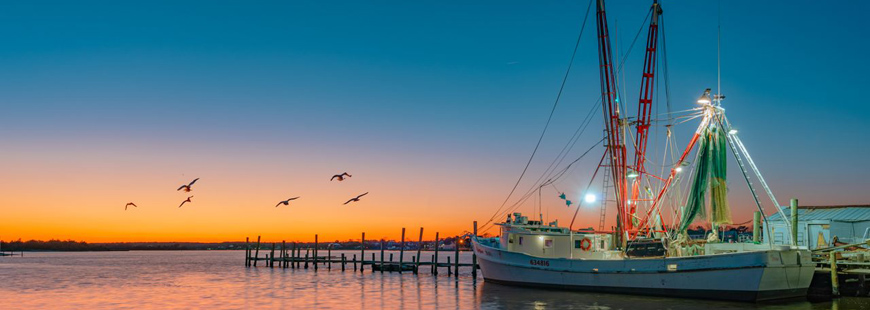
Top photo: Fishing boat docked in Swansboro Harber, North Carolina, via Pexels
On August 17, 2026, a Superior Court judge in Wake County, North Carolina found that, in managing its marine fisheries, North Carolina “has failed to meet its ‘obligation to manage and protect fisheries for the benefit of the general public’ as required under the public trust doctrine, failed to ‘keep fisheries safe from injury, harm, or destruction for all time’ as required under [the North Carolina state constitution], and failed to ‘protect the harvestable fish population for the benefit of all its citizenry’ as [also] required under [the state constitution].”
The decision was handed down in the matter of Coastal Conservation Association v. State of North Carolina, a lawsuit filed in 2020, but not heard until early 2026. Since the suit began, North Carolina has filed various motions seeking to keep the matter from going to trial, and has taken appeals to a higher court when its motions were denied. However, all of the state’s efforts to defeat the plaintiffs on procedural grounds failed, and in January 2026, the trial finally began.
The initial phase of the trial lasted for five weeks, and involved extensive testimony from expert witnesses, state officials, and recreational fishermen. Its sole purpose was to determine whether the state was liable to the public for its failures to maintain healthy stocks of marine fish.
The court decided that it was.
In reaching its decision, the court made over 300 findings of fact, including findings that
Most North Carolina citizens who are shore-based anglers have limited boat access or no boat access, and for that reason, they have historically depended on certain readily accessible, mostly estuarine finfish species. Those species include Atlantic croaker, blue crab, Eastern oyster, flounder of various species, hard clam, kingfishes (sea mullet), red drum, river herring, spot, spotted seatrout, striped bass, and weakfish…
In the 1960s and 1970s, sought-after fish like spot, Atlantic croaker, weakfish, and flounder were highly abundant. Recreational anglers with little experience could harvest dozens of weakfish in a single day on the Pamlico Sound, stock their freezers on vacation trips, catch flounder from docks along the banks of the sound, and harvest enough Atlantic croaker for neighborhood fish fries.
In the 1970s, however, commercial finfish landings increased dramatically. Between 1972 and 1981 alone, commercial finfish landings increased from 40 million pounds to over 90 million pounds…
Commercial finfish landings then began a precipitous decline in the late 1970s and early 1980s. Today, they are half what they were in the early 1970s. [citations omitted]
Those findings are of critical importance, as they go to the heart of the case—the argument that North Carolina has an obligation to manage marine fish stocks for the benefit of the general public, and the argument that a provision of the North Carolina state constitution, adopted in 2018, granted individuals a constitutionally-guaranteed right to hunt, fish, and harvest wildlife.
In 2022, the North Carolina Court of Appeals upheld the trial court’s ruling against the state’s motion to dismiss the lawsuit. The appellate court’s decision said, in part, that “the State contends that the language of this [constitutional] provision places no affirmative constitutional mandate on the State to preserve the right of the people to hunt, fish, and harvest wildlife for the public good. We disagree.”
Instead, the court found that the right to harvest fish would be meaningless unless the state managed fish stocks for long-term sustainability, saying “[T]he General Assembly, when drafting the proposed amendment, intended to create an affirmative duty on the State to preserve the right of the people to fish and harvest fish. However, the right to fish and harvest fish would be rendered meaningless without access to fish. Therefore, the State’s duty necessarily includes some concomitant duty to keep fisheries safe from injury, harm, or destruction for all time.”
While much of the court’s decision focused on the public trust and constitutional issues, it also found that the state failed to meet its statutory obligations to manage marine fish stocks pursuant to the Fisheries Reform Act, which was adopted by the North Carolina General Assembly in 1997, and requires that the state’s fisheries be managed for “long-term viability.”
The court decision notes that Katherine Rawls, the North Carolina Department of Marine Fisheries’ Fisheries Director, stated on the record that “long-term viability is the standard” for the state’s management of marine fisheries, and that long-term viability “means more than just sustainable harvest.” Other state witnesses supported her assertions, and none disagreed.
Experienced fisheries scientists, who served as expert witnesses, also supported Ms. Rawls’ statements.
The court found that, in 2017, North Carolina established a set of criteria for whether a fish stock was viable. “Those viability criteria required that a stock cannot be overfished, that overfishing of the stock cannot be occurring, and that the stock must exhibit the following: stable or increasing trends in average length and weight, stable catch per unit effort, stable spawning stock biomass, stable juvenile abundance indexes based on historical averages, stable age structure that includes representatives of the older age classes, and stable or declining trends in fishing mortality.”
The court also noted that when plaintiffs, during the course of pre-trial discovery, served an interrogatory on the state, asking which North Carolina-managed fish stocks exhibit long-term viability, the state proved evasive, only replying that it “makes no contention regarding whether any of the species listed exhibit long-term viability.”
However, Dr. Louis Daniel, who worked for the North Carolina Department of Marine Fisheries for 21 years, served as the state’s Marine Fisheries Director from 2007 to 2016, and appeared as an expert witness for the plaintiffs, testified that of the 13 stocks managed by North Carolina, five were overfished, one is experiencing overfishing, and the status of the other seven is unknown; thus none of them could be said to exhibit long-term viability under the criteria established in 2017. Dr. Daniel’s testimony then went a step further, when he said that after having the Fisheries Reform Act in place for nearly 30 years, “we haven’t got a success…and we haven’t rebuilt any stocks.”
For eight days of the five-week trial, plaintiffs experts testified as to how North Carolina’s marine fisheries management failed to achieve long-term viability for any species, failed to rebuild overfished stocks, failed to end overfishing, failed to get bycatch under control, and failed to provide adequate fisheries law enforcement. The court noted that North Carolina failed to rebut such expert testimony. Moreover, the court found that “In contrast, the State did not present any expert who testified as to the sufficiency of the State’s management at the system level (i.e., the agency level or commission level)…Instead, the State took an unusual approach: Rather than retain independent, qualified, outside experts in fisheries management, the State simply designated seven of its DMF employee fact witnesses as experts, then sought to elicit various expert conclusions from them about their employer.”
Given such an approach, it might not be surprising that the court found in plaintiffs’ favor. However, the state’s decision not to rebut the plaintiffs’ experts’ testimony with its own expert witnesses has elicited criticism from members of the commercial fishing community.
Although the plaintiffs’ core argument was that North Carolina failed to properly manage its marine fisheries, the focus of that argument was that the state failed to properly regulate its commercial, rather than its recreational, fisheries. Shrimp trawling within the Pamlico Sound, and what the plaintiffs considered underregulated gill net fisheries, along with the bycatch and dead discards such fisheries allegedly produce, were the targets of particular criticism.
Dr. Daniel, in a report provided by him as an expert witness, noted that North Carolina “allow[s] commercial gears that have been prohibited in other jurisdictions because of their extraordinarily high levels of bycatch,” singling out estuarine shrimp trawling and gillnets. That led the court to find, “That allowance has created a management problem virtually unique to North Carolina, making the State’s disregard of the high number of discards from those gears highly risk-prone and contrary to sound management principles.”
Commercial fishing interests thus felt targeted by the lawsuit, but without anyone to advocate for their interests in the matter. The North Carolina Fisheries Association (NCFA), the commercial industry’s primary trade organization, sought to intervene in the action as a defendant, but its motion to do so was denied by the court, making it impossible for the association to present witnesses or brief issues of concern to the state’s commercial fishermen.
The denial of that motion, coupled with North Carolina’s apparent unwillingness, or perhaps inability, to rebut the plaintiffs’ expert witnesses, left some commercial fishermen questioning the fairness of the process. One fisherman, posting on Facebook, complained that
the State appears to have mounted a defense so inadequate that the judge repeatedly describes important parts of CCA’s case as ‘unrebutted,’ ‘uncontested,’ or met with ‘no evidence to the contrary.’ Meanwhile, the commercial fishermen, seafood businesses and working waterfronts that may actually bear the consequences were not permitted to be parties defending their own interests…
And where was the serious defense of the other side? Where was the history of declining commercial effort, decades of increased regulations and gear improvements, natural boom-and-bust cycles, recreational mortality, habitat loss, water quality, development and environmental change? Where was the challenge to treating declining commercial landings as if they were simply a graph of declining fish abundance? …
Who actually defended North Carolina’s commercial fishermen and North Carolina seafood consumers who depend on them?
Fairness is always subjective, and the commercial fishermen’s perception of inequity doesn’t necessarily mean that anything unfair occurred, but people’s perceptions will undoubtedly affect how they approach the next steps of the process.
In this case, the next step is the “remedy” phase of the trial.
Now that the court has established liability, it has given the parties 45 days to prepare a report intended to help the court craft a remedy for the state’s failure to properly manage its fisheries. The plaintiffs are seeking a permanent injunction requiring North Carolina to take corrective actions to rebuild its fisheries and ensure their long-term viability. Restrictions, and possibly even a ban, on shrimp trawling in North Carolina’s estuaries, strict regulation of gill net fisheries, hard-poundage annual catch limits, and increased data collection requirements are all likely to be considered.
State officials are expected to ask the court to craft a compromise remedy that allows fish stocks to rebuild without threatening the livelihoods of commercial fishermen and radically reshaping the state’s commercial fishing industry. Although commercial fishing practices are targeted in the lawsuit, whatever remedy the court ultimately imposes will probably also have a significant impact on recreational fishermen, as it would be very difficult to rebuild depleted fish stocks unless additional restrictions are placed on both the commercial and recreational sectors.
So far, the state has not issued a formal response to the court’s decision, so it is not clear whether it will accept the finding of liability, or whether it will seek to have the Court of Appeals overturn the decision. However, if an appellate court upholds the trial court’s findings, or if the state chooses not to appeal, the decision in Coastal Conservation Association v. State of North Carolina is likely to have a profound impact on how North Carolina manages its marine fisheries.
The decision’s impacts outside of North Carolina aren’t as clear.
Coastal Conservation Association v. State of North Carolina probably represents the first time that a court anywhere in the nation has found that the public trust doctrine—the principle that the government holds certain natural resources in trust, maintaining and protecting them on behalf of the public as a whole—creates an affirmative duty for the state to maintain marine fish stocks at healthy and sustainable levels. While the decision isn’t binding on courts outside of North Carolina, it does constitute a persuasive precedent that courts in other states could choose to follow if they found its logic compelling.
If other states adopt similar interpretations of the public trust doctrine, it could usher in a new era of fisheries management, in which states could no longer ignore overfished stocks and chronic overfishing, but instead would be held responsible for the state of their marine fish populations.
At the same time, the court’s decision was very North Carolina-specific, as it was heavily reliant on a section of the state constitution which created a right to hunt, fish, and harvest wildlife, as well as on the language of North Carolina’s Fisheries Reform Act. While at least nine coastal states have, over the past twenty years, added language to their state constitutions that created a right to hunt, fish, and harvest wildlife, arguably making the decision’s constitutional basis relevant to those states as well, the Fisheries Reform Act is unique to North Carolina, rendering those sections of the decision that relate to that statute, including the long-term viability standard, unique to North Carolina as well.
Thus, the court’s finding that North Carolina is legally obligated to manage its marine fish stocks for the benefit of the general public is only an intermediate step in the campaign to improve the state’s saltwater fisheries management program.
Should the decision not be overturned on appeal, and should the court be willing to impose a remedy that will materially improve North Carolina’s approach to marine fisheries management, Coastal Conservation Association v. State of North Carolina will, at the least, lead to better fisheries management outcomes in a state with a long history and deep traditions of commercial and recreational fishing.
Should courts in other states follow the precedent set by the North Carolina court, then Coastal Conservation Association v. State of North Carolina may earn its place as a landmark decision that changed the course of saltwater fisheries management in multiple jurisdictions.
It is far too early to know what the final legacy of this lawsuit will be, but it is not too early to hope that Coastal Conservation Association v. State of North Carolina will go far to change the management status quo, not only in North Carolina, but on every coast of the United States.