

This article was originally published on the Natural Resources Defense Council’s (NRDC) website and is republished with permission. Top photo: Wild Pacific salmon reef net fishing boats off Lummi Island, Washington. Credit: Edmund Lowe/Getty Images.
A half century of progress has been made toward abundant fisheries and thriving coastal communities, but there is still much work ahead.
Protecting and sustaining the last major wild food source on earth—marine fisheries—should be an easy yes for decision-makers across the political spectrum. For five decades, our landmark fisheries law, the Magnuson-Stevens Fishery Conservation and Management Act (MSA), has stood out for its conservation successes and enduring bipartisan support in Congress.
Follow on Substack
The success or failure of fisheries management reverberates far beyond the docks, affecting food security, local livelihoods, the character of our coastal communities, and the long term health and biodiversity of our oceans. The urgency to get these decisions right is intensified by climate change, as fish populations off our coasts are moving into cooler waters, decreasing in productivity, and facing more frequent extreme events such as marine heat waves. Much has changed in the last 50 years, and various management challenges call for fresh approaches.
As the MSA marks its 50th anniversary, there are successes to celebrate—and just as much work to do to ensure wild-caught fisheries are viable for decades to come.
Bringing back the fish: A conservation law born of crisis and improved over time
Fifty years ago, our fisheries were in deep trouble. Many decades of increased overfishing, weak management, and heavy foreign fishing pressure in U.S. waters had pushed fish stocks to the brink. Lawmakers responded with a bold new framework for fishery management.
Named for the two Pacific Northwest senators—one Democrat and one Republican—who championed the legislation, the MSA enshrined a new set of standards into federal law. The new law had the stated overarching goal to prevent overfishing while achieving levels of fishing that provide the greatest overall benefit to the nation. It established regional fishery management councils and required rules to prevent overfishing, conserve fishery resources, and benefit the long term sustainability of marine ecosystems within federal waters (generally 3 to 200 nautical miles off U.S. shores).
Today, U.S. fisheries are among the best managed in the world and have served as a model for other countries developing their own rules. But we did not get here easily. The MSA’s wins are the result of successive amendments that strengthened the law through bipartisan efforts and close collaboration with fishermen, scientists, conservationists, and managers. In 1996, rebuilding requirements were introduced into the law, due to widespread overfished stocks and management practices that were failing to address the problem. In 2006, in response to continuing chronic overfishing, particularly in certain regions and fisheries like the New England groundfish fishery, Congress required managers to implement annual catch limits that could not exceed scientific advice in all managed fisheries.
Two decades later, the MSA has shown that putting long-term fisheries sustainability first—and sticking with it—can work. We have successfully rebuilt 52 fish stocks and significantly curbed overfishing in U.S. fisheries. Iconic species, like Atlantic sea scallops and black sea bass on the East Coast, have been rebuilt from overfished levels and support some of the most valuable fisheries in the world.
Our fisheries are celebrated as powerhouses for coastal economies and the communities that rely on them, supporting an estimated two million jobs and contributing more than $300 billion to our economy. And while the time has not been right for a full reauthorization of the MSA in the current Congress, dedicated champions on the Hill have continued to lead policy discussions and propose critical updates to the MSA with a renewed focus on strong management measures in the face of climate change. At the forefront of these discussions has been the Sustaining America’s Fisheries for the Future Act, introduced by Representatives Jared Huffman, James Moylan, and Ed Case (see NRDC’s summary).
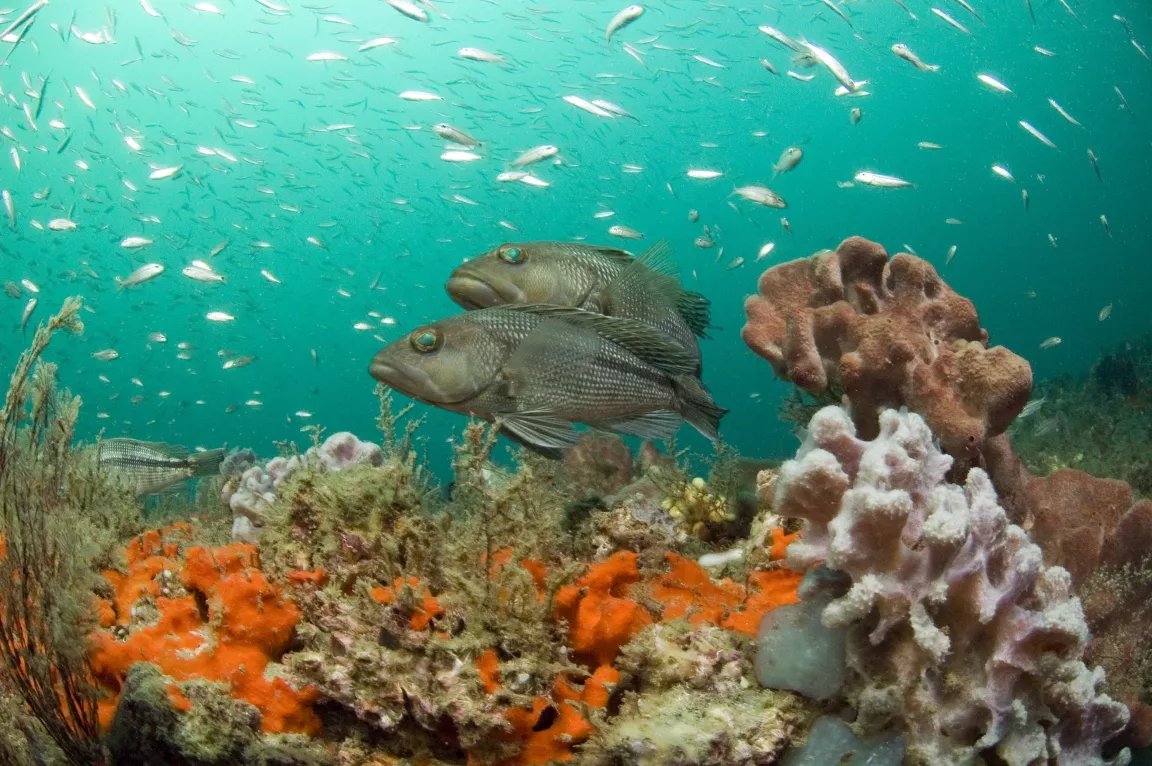
Black sea bass are one of several fish species being tracked by researchers using acoustic tags that “ping” receivers around the reef at Gray’s Reef National Marine Sanctuary in the Atlantic Ocean off the coast of Georgia. Credit: Greg McFall/NOAA
Uneven progress and warning signs
Despite historic achievements in sustainable fisheries management, the MSA’s success is neither complete nor guaranteed. Some fisheries have struggled to recover while others remain subject to unsustainable fishing rates and risky management decisions. Here are some of the latest trends showing this uneven progress:
- At least 42 stocks (approximately 20 percent of all known fish stocks) remain overfished, meaning their population levels are too low to support maximum sustainable yield (the standard set by the MSA) and therefore cannot yield optimal economic and social benefits, as the law dictates. This includes iconic stocks like Atlantic cod that are still struggling to recover from historical, chronic overfishing. It also includes a number of stocks that were previously rebuilt and are now sliding backward again.
- Rebuilding progress has slowed. While 52 stocks have been declared rebuilt since 2000, that number is stalling out for the remaining depleted stocks. Several important forage species (species particularly important as food sources for other fish and marine wildlife) remain on the overfished list, including Atlantic mackerel and Pacific sardine, as do several sharks and other highly migratory species.
- Overfishing continues despite legal requirements to prevent it. While overfishing, or fishing at an unsustainable harvest rate, is near all-time lows, it still currently affects 14 stocks (with known status). Catch overages in some regions have resulted in new additions to the overfishing list.
- Other systemic problems remain too, such as bycatch (i.e., unintended catch), destructive fishing practices that damage marine habitat, and loopholes that leave hundreds of ecologically important fish species poorly managed or unmanaged.
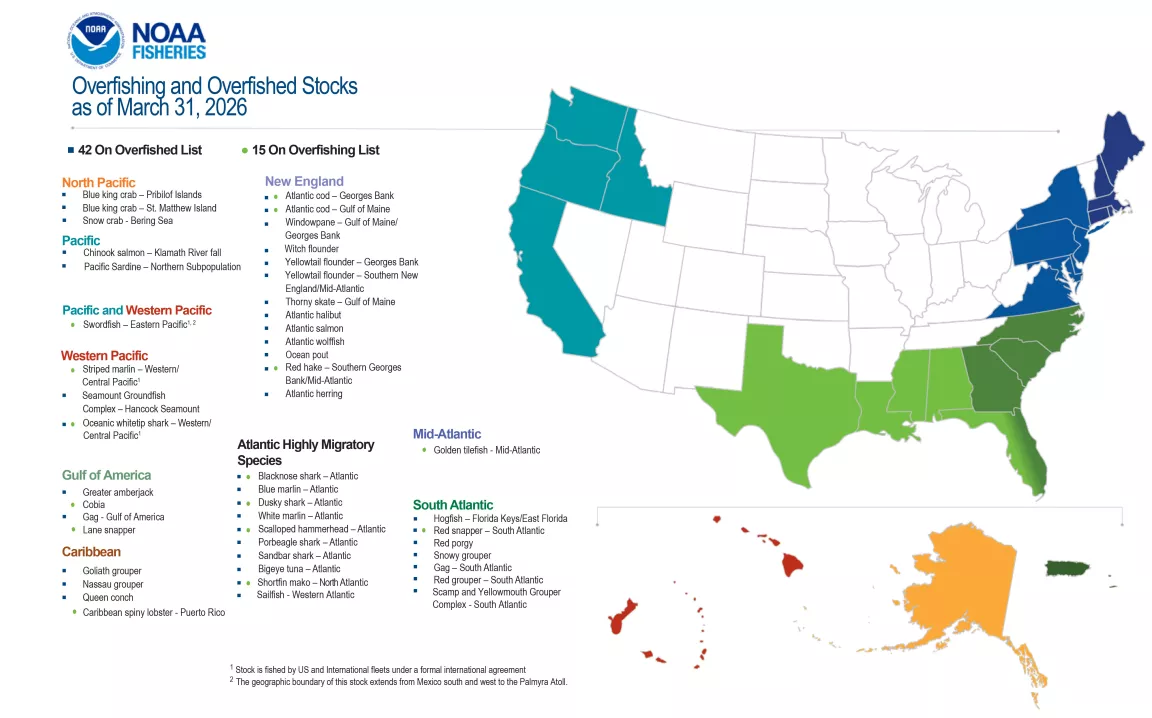
Overfishing and overfished stocks as of March 31, 2026. Credit: NOAA Fisheries
Key priorities for securing the future of fishing
The MSA’s unique system of stakeholder-driven, science-based fishery management has shown us that prioritizing long-term fisheries sustainability can work. But in the face of ongoing management challenges—compounded by the climate and biodiversity crises—we must prioritize long-term solutions that can guide the MSA’s next chapter:
- Put an end to chronic overfishing and rebuild overfished stocks: Loopholes that allow overfishing to go unchecked, or ones that allow rebuilding plans to continually fail to meet their goals, must be closed. Poor accountability to catch limits in certain fishing sectors must be fixed. The conservation mandates that made the MSA successful should be reinforced, not weakened.
- Defend NOAA and science: NOAA’s scientists are widely recognized as the best in the world. The cuts and layoffs at NOAA enacted and proposed by the White House on its path of deregulatory destruction (including a recently proposed $1.6 billion budget cut) would destroy our world-class fisheries. We must protect the agency’s ability to deliver the research, monitoring, and safety services that fishermen and managers rely on. Champions in Congress have fiercely defended NOAA and National Marine Fisheries Service budgets and continue to advocate for fisheries funding.
- Strengthen protections for important fish habitats: Protecting the diverse marine habitats that support fish populations is an important but greatly underutilized element of sustainable fisheries management under the MSA. As covered in NRDC’s A Safety Net for Ocean Fisheries report, better mitigating the adverse impacts of fishing on habitat will help our fisheries survive the climate change–related disruptions now underway in our oceans.
- Safeguard forage fish and other marine wildlife: The MSA lacks both strong standards to protect the forage fish that underpin ocean food webs and the requirements to safeguard precious marine wildlife, such as whales and turtles, from being caught or entangled in fishing gear. We will continue to advocate for reforms, both in legislation and under existing laws, to balance protecting marine biodiversity and productive fisheries.
- Advance climate-ready fisheries management: There is an urgent need for policy guidance to respond to rapidly changing oceans and increasing extreme events. Climate considerations must be integrated throughout the fisheries management process. This includes addressing shifting fish distributions, investing in climate informed science, and modernizing data collection.
- Level the playing field against unfair and illegal fishing: Globally, illegal, unreported, and unregulated (IUU) fishing—and abusive labor practices—continues to threaten fisheries sustainability while flooding global markets with cheap, illicit seafood. The United States imports more seafood by value than any other country, including billions of dollars linked to IUU fishing. Stronger seafood import controls and international enforcement are essential to protect U.S. fishermen and uphold sustainability standards. Lawmakers on both sides of the aisle have supported leveraging U.S. policy tools such as the MSA to block trade of illegal seafood and boost international enforcement, and we hope to see much more progress on this issue in the coming year. These policies should be complemented with more support for programs to support sustainable U.S. fishing communities, such as grants programs for working waterfronts and updates to the fisheries disaster relief program.
The Magnuson Stevens Act has proven that fisheries conservation and economic vitality are not competing goals—they are inseparable. The hard won lessons of the past also show that, without a strong conservation mandate, political pressure and short term thinking can quickly return fisheries to the days of boom-and-bust cycles. As we mark the MSA’s 50th anniversary, now is the moment to recommit to the principles that made our fisheries law successful, strengthen what works, and ensure the law remains a global model for sustainable fisheries in an era of unprecedented change.