
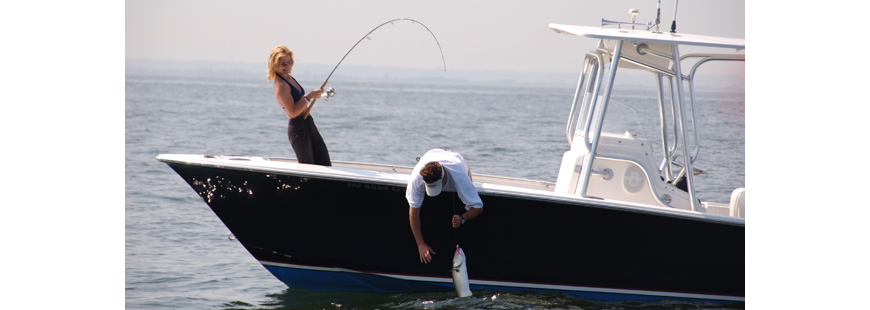
Top photo by John McMurray
On April 13, 2026 the National Oceanic and Atmospheric Administration issued a press release announcing its newest version of the National Saltwater Recreational Fisheries Policy (Policy), which stated that “The purpose of this policy is to provide guidance for NOAA Fisheries’ consideration in its deliberations pertaining to development and maintenance of enduring and sustainable high quality saltwater recreational fisheries.”
The release further stated that “The policy identifies goals and guiding principles to be integrated into NOAA Fisheries’ planning, budgeting, decision-making, and activities regarding saltwater recreational fishing and includes examples of implementation concepts and strategies supported by NOAA Fisheries.”
The Policy replaces NOAA Fisheries’ original National Saltwater Recreational Fisheries Policy, which was adopted in 2015. Although the Policy remains, in principle, substantially similar to the 2015 version, it places more emphasis on the economic aspects of recreational saltwater fishing. The Policy is also somewhat more detailed than the policy that it replaces, and it addresses some issues for the first time.
Thus, while the original policy simply stated that “It is the policy of [NOAA Fisheries] to foster, support, and enhance a broadly accessible and diverse array of sustainable saltwater recreational fisheries for the benefit and enjoyment of the nation,” and described the scope of the policy by saying, “The policy pertains to non-commercial activities of fishermen who fish for sport or pleasure, as set out in the Magnuson-Stevens Act definition of recreational fishing. That could be retaining (e.g., consuming, sharing) or releasing their catches, as well as the businesses and industries (e.g., the for-hire fleets, bait and tackle businesses, tournaments) which support them,” the current Policy places more focus on the business aspects of recreational fishing.
While the first sentence of the current Policy is not meaningfully different from that of the original policy, additional provisions have been added which recognize “new and emerging priorities,” and specifically state NOAA Fisheries’ interest in “protecting the vibrant tourism and recreation industries that depend on healthy coastal ecosystems.” The language setting out the scope of the Policy has also been expanded, by stating the agency’s commitment to promoting and growing sustainable saltwater recreational fisheries.
The Policy’s focus on enhanced sustainability is encouraging, and is further reflected in a lengthened list of “strategic goals.” While the original policy listed only three such goals, including the support and maintenance of sustainable fisheries resources, including healthy marine habitats; promoting recreational fishing “for the social, cultural, and economic benefit of the nation;” and enabling long-term participation “through science-based conservation and management,” the Policy has expanded that list.
The Policy now recognizes five strategic goals. It retains, in substance, the three included in the original 2015 policy, although it now seeks to promote recreational fishing not to preserve its social and cultural virtues, but instead to do it in a way that “maximizes economic growth and supports coastal communities, tourism, and marine recreational industries.”
That change could, if truly integrated into NOAA Fisheries’ decision-making, move managers away from managing fisheries for abundance (described, in one Atlantic States Marine Fisheries Commission document, as “put[ting] the interest of the species before the fishery”), so that anglers might encounter more fish, including some large fish, when they venture out on the water, and toward a fishery managed largely for yield, with a higher fishing mortality rate and a population composed primarily of smaller fish, that is intended to appeal to tourists and other anglers more interested in taking fish home for dinner than in fishing for sport. Managers would place less emphasis on the preferences expressed by individual anglers and more on the preferences of the for-hire fishery and the rest of the recreational fishing industry.
The two new goals are far more benign. One would have NOAA Fisheries “Improve the responsiveness of fisheries management to current and future ocean conditions,” which is about as close to an acknowledgement of climate change and a warming ocean as one is likely to see from the agency, given the current atmosphere in Washington, as well as a reason to hope that NOAA Fisheries might finally confront the issue of shifting fish stocks. The other seeks to “Cultivate active stakeholder engagement in the stewardship of recreational fisheries,” something that could only improve the fishery management process.
Just how all of the goals might be achieved is outlined in the Policy’s final section, “Guiding Principles for the Saltwater Recreational Fisheries Policy.” Such principles, largely carried forward from the earlier policy, include “Foster Stewardship,” “Improve Access,” “Promote Participation,” “Increase Engagement,” “Strengthen Partnerships,” and “Advance Innovative Solutions.” All, on their face, are worthy of support although, as always, the devil is in the details, and in this case, some of the details are worthy of a little extra attention.
For example, in the “Foster Stewardship” section, one proposed strategy is to “Support cost-effective community-based restoration, conservation, and enhancement of essential fish habitats. [emphasis added]” While that all sounds fine at first reading, the qualifications of “cost-effective” and “community-based” restoration and conservation could well get in the way of essential habitat projects. That is particularly true of one of the most effective habitat improvement projects of all, dam removal.
On both the Atlantic coast, in places such as Maine’s Penobscot River, and on Pacific waters such as the Yakima River, the removal of dams that had long prevented anadromous fish from reaching their historical spawning grounds has resulted in immediate benefits to a plethora of fish species. However, dam removal can be both costly and controversial, and requiring it not be both “cost effective” and “community-based” could create severe obstacles to any significant dam removal projects.
The next principle, “Improve Access,” is also problematic, as it immediately leads to the question, “What, precisely, does “access” mean?”
“Improve Access” could mean removing physical barriers that separate anglers from the fish they seek, by providing funding to support working waterfronts, maintaining navigable waterways, or perhaps eschewing the creation of marine protected areas where angling is not allowed. Unfortunately, in recent years, we have also seen the recreational fishing industry use the word “access” as a euphemism for killing fish at rates that exceed the mortality levels recommended by fisheries managers. South Atlantic red snapper provide a recent example.
While removing barriers that keep anglers from their quarry is always a good thing, using “angler access” as an excuse to sidestep science-based fisheries management most definitely is not.
Another potential pitfall can be found under the “Increase Engagement” heading, where one strategy would “Develop and ensure meaningful pathways exist for community knowledge and needs to enter the science and management process. [emphasis added]”
There are potentially two problems here.
One is the concept of “community knowledge.” It is true that people who work on and around the water come to understand, through years and even generations of observation, the relationship between the fish that they catch and other natural phenomena. But recognizing that a relationship exists is very different from understanding why it occurs, and anecdotal observations are not the factual equivalent of data-based scientific conclusions. I once had the deckhand on a trawler insist that some birds, like mayflies, only lived for a single day, a conclusion he reached after fishing during the autumn migration and finding the bodies of scores of warblers and other birds, which died of exhaustion after overrunning Long Island during the night, littering the vessel’s decks in the morning.
Local knowledge can be a starting point for scientific research. Many years ago, commercial fishermen argued that the mandatory escape vents in black sea bass pots were too large. The size of the vents, which were intended to allow undersized black sea bass to escape, were based on fish measured at the surface; the fishermen claimed that water pressure at the bottom compressed fish’s bodies and allowed legal-sized fish to escape. Subsequent research demonstrated that the fishermen’s claims were true.
At the same time, anyone who has attended many fisheries hearings, in particular hearings on regulations intended to reduce catch, knows that fishermen will invariably rise to claim that “the science is wrong,” “there are plenty of fish out there,” and “we’re on the water every day and know what’s really going on.” Such comments are frequently made by for-hire vessel operators and other members of the recreational fishing community. While such comments are often made in good faith, they also typically reflect a certain level of confirmation bias, which develops when fishermen focus on good catches made at certain times in certain places and, ignoring other days when fishing is poor, convince themselves that fish populations are healthy and regulations aren’t needed.
The “science…process” should be driven by hard data, and nothing else.
The notion that “community…needs” should “enter the science and management process” is equally dangerous, for biology is objective, while “need” is a very subjective concept. Biology is also non-negotiable. If scientists determine that a certain, specified level of fishing mortality will cause a fish stock to decline, the fact that the fishing industry, or a fishing community, supposedly “needs” to harvest more fish to remain viable will not change the fact that, if that threshold level is exceeded, abundance will decline, and fishermen will end up catching less, not more, in the long term.
Sticking to the science, and only to the science, is critical to a sustainable management process.
Finally, under the “Advance Innovative Solutions” heading, there is the strategy to “Develop and apply aquaculture tools and technologies that support recreational fisheries and coastal ecosystems.” Stripped of its formal wording and reduced to the language of the everyday angler, that means “Build more fish hatcheries,” and some recreational fishermen will have no problem with that, as hatcheries allow jurisdictions to dump a multitude of artificially propagated fish into coastal ecosystems, so that anglers can take more fish home.
Texas, which has long employed hatcheries to produce red drum, spotted seatrout, and other coastal species, readily admits that hatcheries “are a tool used…to ensure that harvest levels are sustained.” Hatcheries free fisheries managers from the need to maintain fish populations that are capable of sustaining themselves through natural reproduction, and from the restrictive regulations that are often needed to do so. Instead, hatcheries allow anglers to chronically overfish popular species, and remove fish from coastal waters at rates that could never be supported by natural reproduction.
Yet, once marine fisheries managers and recreational fishermen become dependent on hatcheries, it is very difficult to end that dependence, even though hatcheries do little to restore natural fish populations. The first hatcheries for Pacific salmon were built in the late 1800s, and many others have been built since. Yet, despite nearly 150 years of hatchery production, 28 runs of Pacific salmon and the closely-related steelhead trout are currently listed as “endangered” or “threatened” under the federal Endangered Species Act, while no run that was previously “enhanced” with hatchery fish has ever been restored to the point that it could sustain itself solely through natural reproduction. The story is the same for other species, including red drum, spotted seatrout, southern flounder, Florida pompano, and white seabass; hatcheries may provide anglers with more fish to take home, but at least in saltwater, they have never led to a self-sustaining, naturally reproducing population of any recreationally important species.
It could thus be argued that hatcheries are the antithesis of effective fisheries management, and not a strategy that the Policy ought to contemplate.
The bottom line is that the Policy isn’t perfect. It contains some clearly problematic provisions. Yet it remains a valuable document that built on its 2015 predecessor and, if followed by NOAA Fisheries, should provide real benefits to both recreational fishermen and the fishes that they pursue.