
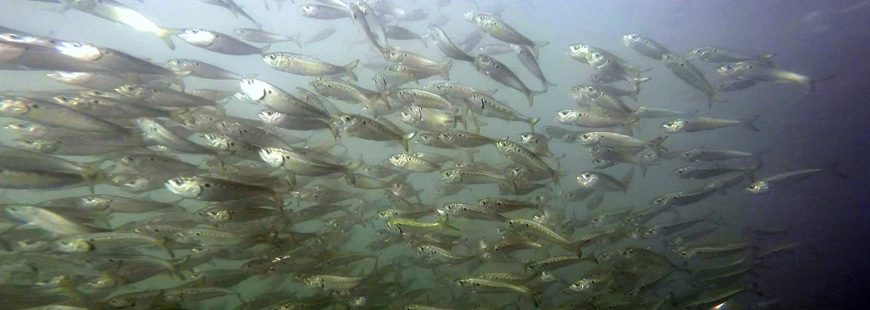
PART I: ASMFC Struggles with Menhaden Management
Atlantic menhaden are an important forage fish all along the East Coast, feeding everything from striped bass off New England to king mackerel in the southeast. Their appeal isn’t limited to predatory fish; they are also an important part of the diets of marine mammals and piscivorous birds.
Menhaden also support a very large commercial fishing industry, which has two primary components. One is the bait fishery, which catches menhaden that both commercial and recreational fishermen use as bait for other species. The other is the so-called “reduction fishery,” which processes menhaden into fish meal, oil, and other industrial products. The reduction fishery accounts for most of the menhaden harvest, landing 131,800 metric tons of Atlantic menhaden in 2023. That is a large decrease from historical landings levels, which peaked at 715,150 metric tons 70 years ago and exceeded 400,000 metric tons as recently as 1990. The bait fishery is substantially smaller, landing 60,420 metric tons of Atlantic menhaden in 2022 and 48,550 metric tons in 2023.*
While the bait fishery is largely composed of small-scale operations that exist in almost every Atlantic coast state, the Atlantic menhaden reduction fishery is prosecuted by a single company, Ocean Harvesters, which sells its entire catch to Omega Protein Corporation, a subsidiary of the Canadian seafood conglomerate, Cooke, Inc. Both Ocean Harvesters and Omega Protein are headquartered in the unincorporated community of Reedville, Virginia, which makes Virginia a key participant in the menhaden management debate.
In recent years, biologists believed that the menhaden stock was doing extremely well, as a 2020 benchmark stock assessment found that the stock was neither overfished nor experiencing overfishing; fishing mortality was well below the fishing mortality target, while fecundity, used as the measure of menhaden abundance, was well above target. A 2022 stock assessment update confirmed those findings.
Still, some conservation advocates feared that the large fishing vessels used in the reduction fishery might be causing localized depletion, particularly in the Chesapeake Bay, and depriving predators of needed forage. A research paper that blamed osprey nest failure in a small corner of the Chesapeake Bay on such supposed depletion only increased such advocates’ concerns.
However, no one has yet demonstrated that localized depletion is actually taking place. In 2009, scientists from the Council of Independent Experts conducted a peer review of the Chesapeake Bay Menhaden Research Program, which is run by the National Oceanic and Atmospheric Administration’s Chesapeake Bay Office. They ad https://asmfc.org/wp-content/uploads/2025/02/aug09boardproceedings.pdf vised that, while localized depletion might possibly occur, it would probably occur only at the level of a single tributary, not across the entire Bay.
They also advised that, before trying to determine whether such depletion exists, fishery managers should define what the term “localized depletion” means, a simple first step that, more than 15 years later, has not yet been accomplished.
Nonetheless, the Atlantic States Marine Fisheries Commission’s (ASMFC) Atlantic Menhaden Management Board (Board) chose to take a precautionary approach toward menhaden in the Chesapeake Bay by instituting a cap on the amount of menhaden that may be removed from the Bay each year (Bay cap). The original Bay cap, which was adopted in 2006, was intended to merely prevent an increase in the reduction fleet’s landings by limiting such landings to the average tonnage of menhaden removed by the fleet each year during the period 1999-2004.
While the original Bay cap permitted the reduction fleet to remove slightly more than 100,000 metric tons (mt) of menhaden from the Chesapeake Bay each year, the Board has since gradually reduced it to the current cap of 51,000 mt.
Thus, menhaden management seemed to be on the right track, until a stock assessment update released in October 2025 (2025 update) found that earlier stock assessments had overestimated the species’ natural mortality rate. When a more accurate estimate of natural mortality was used in the latest assessment, estimates of biomass and fecundity declined, while the estimate of fishing mortality increased. Although the stock is still neither overfished nor experiencing overfishing, the fecundity estimate is now only slightly above the threshold used to define an overfished stock.
The 2025 update informed the Board that the total allowable catch (TAC) it had set for the years 2023-2025, 233,550 metric tons, raised the fishing mortality well above its target level. In order to achieve a 50% probability of keeping fishing mortality at or below the target, the TAC would have to be reduced by 54%, to no more than 108,450 mt.
So, when the Board met in October 2025, it faced a problem. Cutting landings back to 108,450 mt in a single year would have severe economic impacts on the menhaden fishing industry, while leaving the TAC unchanged might do real harm to the stock. The Board had already received multiple reports from fishermen and various conservation organizations suggesting that menhaden abundance was declining. Fishermen failed to land their full TAC in 2023 or 2024, falling about 20% short in both years, another sign that that abundance might be waning.
The Board was sharply divided on how to proceed. Matt Gates, the administrative proxy for Connecticut, moved to set the TAC at 108,450 mt for the years 2026-2028, a motion seconded by Massachusetts’ Governor’s Appointee, Ray Kane. Mr. Gates said, “This is a TAC that is informed by the best available science, and setting a TAC higher may not provide enough menhaden to fill their role in the ecosystem. This includes providing striped bass forage, the conservation of which we have set aside an entire day at this meeting to discuss.”
Dr. Allison Colden, a legislative proxy for Maryland and the Maryland executive director for the Chesapeake Bay Foundation, supported the motion, noting that
when the science shows that the Board is justified in increasing the Total Allowable Catch for this fishery we have done so. In then last four out of five times we have set specs for this fishery, the science has said that we had a reasonable risk to take in increasing the coastwide quota, and we have done that…I would encourage this Board to think just as we were confident in increasing the Total Allowable Catch when the science says we should, that we need to be as willing to take reductions when the science indicates that is warranted as well.
Not surprisingly, the Virginia delegation wasn’t happy with Mr. Gates’ motion, so Joseph Grist, the acting director of Virginia’s Marine Resources Commission, offered a substitute motion that would set the 2026-2028 TAC at 186,840 mt. While that represented a 20% reduction in the TAC, it was more show than substance; since the menhaden fishery was already falling about 20% short of catching their entire TAC. Mr. Grist’s motion effectively capped landings at their current levels, but didn’t reduce them at all.
The substitute motion was seconded by Eric Reid, the legislative proxy from Rhode Island.
Mr. Grist justified his motion by saying,
the proposed TAC is associated with a 0% probability of exceeding the [Ecological Reference Point] fishing mortality threshold in 2026 through 2028, and a low 2 to 4% probability of falling below the [Ecological Reference Point] fecundity threshold during the same period…To reduce [the TAC] any further than 20% would put at risk, directly or indirectly, hundreds, if not thousands of American jobs across several states. It will also result in the decrease of supply and increase in demand and prices of menhaden that are utilized by both the commercial and recreational fishing industries across numerous jurisdictions represented around this Board. This motion is made to balance the ecological concerns as well as the socioeconomic issues that have been provided.
And thus, the issue was joined, with proponents of conservative, science-based management squaring off with Board members who were primarily concerned with the economic disruption that might result from a significantly lower TAC.
Mr. Grist’s motion received support from some members of the Board, as well as from a reduction fleet captain, the union that represents reduction industry workers, and from commercial fishermen in other fisheries who need to purchase menhaden for bait. It eventually passed on a vote of 12 to 6.
Another motion to substitute was made, this time by Nichola Meserve, a Massachusetts fishery manager. It read “Move to substitute to set three-year specifications for Atlantic menhaden with the following TAC; 2026=186,840 MT; 2027=152,700 MT, and 2028= to 124,800 MT.” Nicole Lengyel Costa, a Rhode Island fisheries manager, provided a second.
Ms. Meserve explained that “the values in this motion represent a 20% reduction in 2026 followed by two equal reductions of 18.27% in order to reach 124,800 MT in 2028, which is the value associated with the 50% probability of exceeding the [Ecological Reference Point fishing mortality] target in 2028…However, I also recognize that the end TAC of 124,800 metric tons is a significant reduction of 46 percent overall…By phasing it in over three years it does provide for a little more stability.”
Once again, the debate was between those who supported the science and wanted to see menhaden managed with the Ecological Reference Points that were adopted in 2020 to account for the species’ role as a forage fish, and those who emphasized economic concerns. Mr. Reid opposed Ms. Meserve’s motion, saying in part,
You know we’re talking about reduction versus bait…
We’re at a point now there the economic viability, return on investment, return to owner, is so marginal that going in a stepdown approach…we’re going to take the fishery right out of it, because they can’t function at these numbers, and we’re not just talking about lobster bait in Connecticut, Rhode Island, and Maine.
We’re talking about bait all up and down the east coast in many, many forms. We’re also talking about fish oil, which is used in I don’t know how many products, everything from ice cream to paint, and we’re talking about supplements, vitamins, vitamin this, vitamin that, fish oil, which are sent not only throughout this country, but probably around the world.
This is what we’re talking about. We are talking about a giant economic engine for not just people in this room, or on this coast, it’s a worldwide market for a variety of products that the fishery itself produces. We can’t lose sight of that, and I don’t want to lose one drop of market share on any one of those things, because once you lose it you never get it back.
There was more debate, but it didn’t seem to change many minds. Ms. Meserve’s motion failed on a 7 to 11 vote.
But there was one more substitute motion yet to be made, and it was made by Dr. Costa, who tried to thread the needle between locking in the 186,840 mt TAC for three years and calling for greater reductions that didn’t seem to have the support of the Board. She offered a substitute motion that would set the 2026 TAC at 186,840 mt, but would have the Board set the 2027 and 2028 TACs at its October 2026 meeting. Senator Sarah Peake, New Hampshire’s Legislative Proxy, seconded her motion.
After a few brief comments, that motion passed on a vote of 16 to 2, with only Pennsylvania and, predictably, Virginia in opposition.
Lynn Fegley, the Maryland fisheries manager, then put a new motion on the table, which read, “Move to initiate Addendum II to the Atlantic menhaden fishery management plan, to address Chesapeake Bay management concerns. The addendum shall develop periods for the Chesapeake Bay Cap that distribute fishing effort more evenly throughout the season and also develop a range of options to reduce the Bay Cap from status quo to 50%.” That motion was seconded by Robert LaFrance, the proxy for Connecticut’s Governor’s Appointee.
Not surprisingly, Mr. Grist of Virginia spoke in opposition to that motion, too, arguing that the cap is not science-based, but merely “based on whatever the whims of this Board is.” He said that the Board ought to wait until a team of scientists could recommend a new level for the Bay Cap before taking action.
After some debate, and a failed attempt to amend the motion, Ben Landry of Ocean Harvesters expressed some outrage at the new proposal.
I think it is clear to everyone that this is not, you can change the name of it, it’s an Ocean Harvesters Cap and it only applies to the reduction fishery. You can mask it in any way. You know when you have dozens of [menhaden reduction] fishermen in the back [of the meeting room] and it’s just such a callous conversation about, let’s hurry and figure out how we can cut their harvest in the Bay…it’s a little hypocritical to say, my pound netters need more fish, but let’s hurry up and cut it from the reduction industry. Bait fish are fish caught in the pound netters. They are not less ecologically important than those caught in the reduction fishery. I think it’s kind of an indictment, I guess, on the entire Bay Cap, but thank you for your time.
Despite such opposition, the motion passed easily, on a 13 to 2 vote, with two abstentions and the Florida delegation, unable to agree on a position, casting a “null” vote. New Jersey and, of course, Virginia were the two states in opposition.
The meeting closed with much work to be done.
Top photo: Atlantic Menhaden, courtesy of NOAA
*This paragraph has been updated to correct a conversion error in the landing statistics.



Thank you, well said. It’s unfortunate that legislators and regulators seem to believe the industry claims that most any regulation or legislation will result in layoffs or closing of the reduction operation. This is simply not true. For example, there have been a few recent years when reduction only caught about 50% of their bay cap yet they had no layoffs…they simply fished more in the ocean (which is where they belong). We just saw this again in Virginia when a modest bill was killed over job concerns. The fear mongering never ends.